History of Invention
Photo-Induced Electron Transfer: Reading US Patent 4427511
Separating charge with light, and holding it apart long enough to be useful. The problem at the centre of artificial photosynthesis, as one patent document frames it.
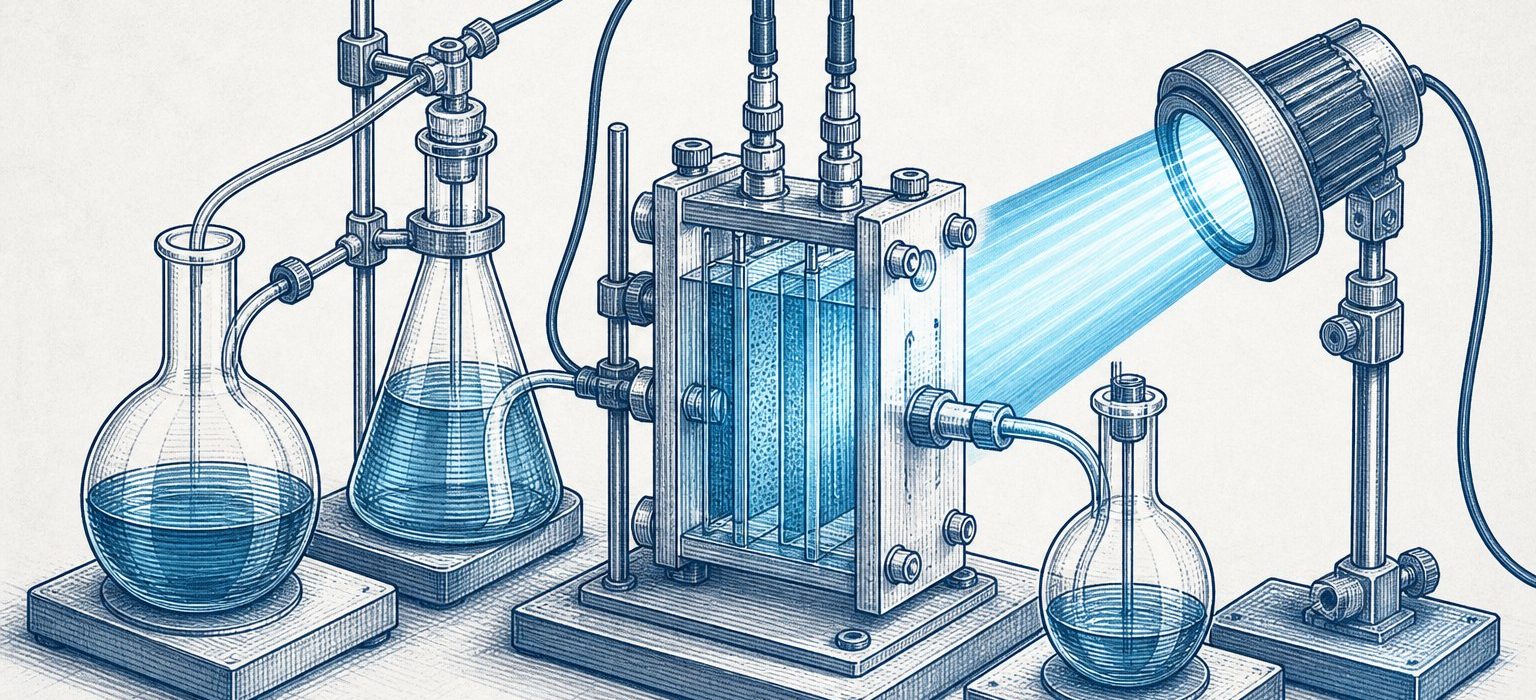
Photosynthesis does something chemists have spent decades trying to reproduce: it absorbs a photon, separates a positive and a negative charge, and then keeps them apart long enough to drive chemistry. Keeping them apart is the hard part. US Patent 4427511 addresses that problem.
The record
The patent is titled “Photo-induced electron transfer method”, filed 1982-08-12 and granted 1984-01-24. The named inventors are Roland Wohlgemuth, Melvin Calvin. It carries no corporate assignee, which in the published record means the rights sat with the inventors at the time of grant rather than with an institution.
The recombination problem
When light separates charge in a simple solution, the separated charges are still near one another. They recombine, typically in nanoseconds, and the absorbed energy is released again as heat. Nothing is gained. Every scheme for storing light energy chemically has to defeat this, and the defeat has to be structural: the two charges must end up somewhere they cannot easily get back to each other from.
Biological photosynthesis solves this with a membrane. Charge is separated across it, and the membrane itself is the barrier that prevents the reverse reaction. A synthetic system that wants the same outcome needs an equivalent piece of architecture — not merely the right molecules, but the right arrangement of them in space.
What a chemical patent claims
Chemical patents of this era characteristically claim a method rather than a substance: a sequence of steps performed on defined materials under defined conditions. That framing matters when reading them. The document is not asserting ownership of a molecule; it is asserting ownership of a way of doing something.
It also means the claim scope turns on the conditions. Change the medium, the wavelength or the arrangement enough and you are outside the claim, even using the same chemistry. This is why practitioners read the claim limitations of a method patent with more care than the compound list.
Context, carefully bounded
Melvin Calvin, one of the two named inventors, is the chemist after whom the Calvin cycle — the carbon-fixation pathway of photosynthesis — is named, work for which he received the Nobel Prize in Chemistry in 1961. This patent, granted more than two decades later, sits in the same broad research interest: understanding photosynthesis well enough to imitate the part of it that stores energy.
It would overstate the document to call it a solution to artificial photosynthesis. It is one filing within a long effort. That is the ordinary condition of patents in a research field, and reading them as anything more is a common error.
Other filings by the named inventors can be reached through the inventor records.
Why a method claim, and what it costs
Claiming a method rather than a composition is a deliberate choice with consequences in both directions. It allows the applicant to cover an operation performed with materials that are individually well known — you cannot patent a compound the literature already describes, but you may be able to patent a specific way of using it.
The cost is enforcement. A composition claim is infringed by anyone who makes or sells the substance, which is a visible, provable act. A method claim is infringed by performing the steps, which may happen inside a laboratory or a production line where nobody outside can observe it. Method patents in chemistry are therefore often more valuable as a defensive record of what was done, and when, than as an instrument for pursuing others.
Two claims, and what that indicates
The record here carries a claim count of two. In chemistry, a small claim set typically means the allowed scope narrowed considerably during examination — applications in well-populated fields often start with twenty or more claims and emerge with a handful, the rest cancelled against prior art.
Reading the granted document alone, you see only the endpoint. The negotiation that produced it lives in the prosecution history held by the patent office, which this archive does not reproduce and which is frequently more informative than the patent itself about what the examiner considered already known.
The wider effort, honestly bounded
Artificial photosynthesis remains unsolved in the sense that matters commercially: no synthetic system converts sunlight into a storable fuel at a cost and durability that competes with the alternatives. A great many patents have been filed along the way, and this is one of them.
Treating any single document as a breakthrough misreads how research fields deposit into the patent record. What accumulates is a long series of specific, incremental, individually modest filings, most of which were never practised. The value of an archive is that it preserves the series rather than only the handful that later looked important.
Other filings naming these inventors are collected in the inventor records.
What an unassigned patent indicates
This record carries no corporate assignee, meaning no assignment had been recorded when it issued and the rights sat with the named inventors. In an academic context that is less common than it sounds, because university employment agreements generally direct inventions to the institution.
Several ordinary explanations fit: the work may have fallen outside the scope of an institutional agreement, the assignment may have been executed but not recorded before grant, or the rights may have been released back to the inventors. The document itself distinguishes none of these. It records an absence, and an absence in a procedural field is weak evidence for any particular story.
This is worth stating because unassigned patents attract narrative — the independent inventor working outside the institution. Sometimes that is what happened. The patent face cannot tell you whether it is.
Where this sits in the archive
Chemistry filings in this archive fall within the CPC chemistry and metallurgy section, reachable from the classification index. Chemical documents reward classified browsing more than most: their titles are frequently opaque by design, and two filings on closely related chemistry may share no title vocabulary whatsoever. The class is often the only thing connecting them.