History of Invention
US Patent 6089347: The Partition Array That Defined Aftermarket Exhaust
A muffler that quietens by routing gas through chambers rather than forcing it through packing. The document behind a sound that a whole aftermarket recognises.
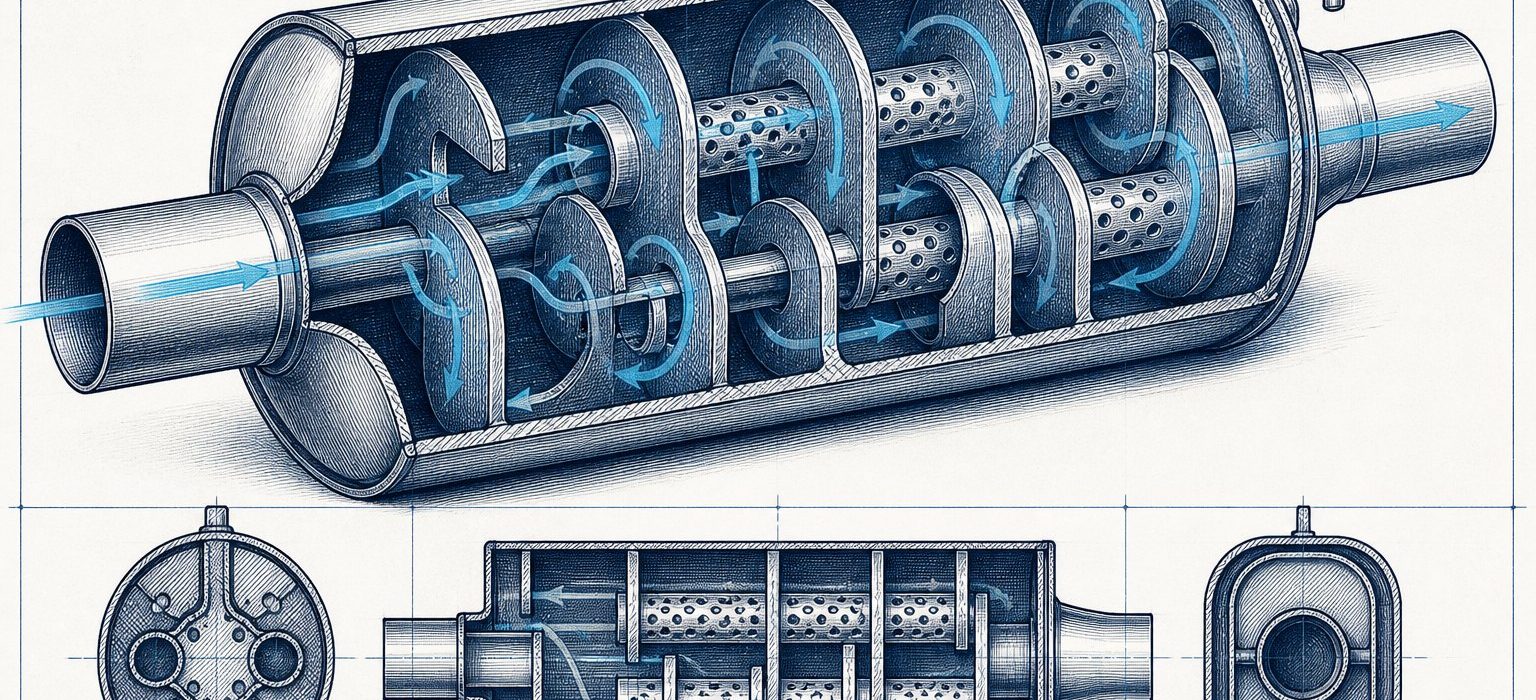
Most mufflers quieten an engine by making the exhaust work harder — forcing gas through perforated tube wrapped in absorptive packing. US Patent 6089347 takes a different route, and the difference is audible.
The record
The patent is titled “Muffler with partition array”. It was filed on 1998-04-13 and granted on 2000-07-18, assigned to Flowmaster Inc, with Ray T. Flugger named as inventor.
Chambers instead of packing
A chambered muffler contains no absorptive material at all. Instead the interior is divided by partitions into a sequence of chambers, and the gas path is routed so that pressure waves are reflected back on themselves. Where a reflected wave meets an incoming wave out of phase, the two cancel. The noise is not absorbed; it is arranged to destroy itself.
The practical consequences follow directly. There is no packing to burn out or blow through, so the acoustic character does not drift over the life of the part. And because the design attenuates by interference rather than by obstruction, it can be tuned: change the partition spacing and you change which frequencies cancel.
Why the sound is distinctive
Interference-based attenuation is frequency-selective in a way that packing is not. Absorptive material takes energy broadly out of the spectrum and leaves a muted version of the original. A partition array cancels hard in some bands and much less in others, which is why chambered exhausts are recognisable rather than merely quieter — the low-frequency content survives while a good deal of the harsh mid-range does not.
That selectivity is the commercial point. The part is not sold as the quietest available. It is sold as sounding a particular way while meeting the noise limit.
Reading a mechanical patent
Documents of this kind reward attention to the figures rather than the prose. The specification text describes chambers and passages in careful, deliberately general language; the drawings show exactly how many, in what order, and with what cross-section. The claims then fix which of those details are essential.
Related filings in acoustics and exhaust silencing can be reached through the classification index, and the assignee’s other records through the assignee listing.
Backpressure, and a persistent myth
Aftermarket exhaust discussion is dominated by the claim that a freer-flowing muffler always makes more power because it reduces backpressure. The engineering is less accommodating. What a naturally aspirated engine needs is not the absence of backpressure but the right pressure waves arriving at the exhaust valve at the right moment — a low-pressure wave during valve overlap helps scavenge the cylinder, and that wave has to be produced by something.
A chambered muffler participates in that behaviour rather than merely obstructing less. The partitions reflect waves, and reflected waves travel back up the system. This is why chambered designs are specified by chamber count and spacing rather than by a single flow figure: the geometry is doing acoustic work in both directions.
What the partitions have to survive
The interior of a muffler is a hostile place: repeated thermal cycling from ambient to several hundred degrees, corrosive condensate at every cold start, and continuous vibration. A design with no absorptive packing has one clear advantage here — there is no consumable component. Packing degrades, migrates and eventually exits through the tailpipe, and when it does the acoustic character changes permanently.
The partitions themselves have to be secured against a pressure environment that reverses many times per second, which is why the attachment of the partitions to the shell is a substantive part of a specification of this kind and not a detail. Where and how they are fixed determines whether the part holds its acoustic properties for years or for months.
Reading the record around it
The filing and grant dates on this record are two years apart, which for a mechanical filing in a crowded field is fast. It suggests examination that did not run into extensive prior-art objections — not proof of it, but a reasonable inference, and the kind of signal the front-page dates carry once you know to look for it.
Acoustics and silencing filings can be reached by subject through the classification index; the assignee’s other records sit in the assignee listing. The full specification, with the figures showing the chamber arrangement this summary describes only in words, is linked from the patent record itself.
How noise limits are actually measured
A muffler is not designed against a single number. Vehicle noise regulation measures a pass-by figure under defined conditions — a specified approach speed, a specified acceleration, microphones at a specified distance — and it is that test the exhaust has to satisfy, not a static reading taken at the tailpipe.
The distinction changes what a designer optimises. Pass-by testing weights the frequencies most audible to a bystander and captures the system under load, which is where an interference-based design either works or does not. A part that is quiet at idle and unacceptable under acceleration fails the test that matters while passing the one people perform in a car park.
It also explains why exhaust components are certified as systems rather than individually. Header, pipe length, resonator and muffler interact acoustically; swapping one changes the behaviour of the rest. A patent covering the muffler alone claims one element of a chain whose performance is only meaningful assembled.
Reading this record against its neighbours
The value of holding a document like this in a classified archive is comparison. Silencing filings from the same period, reached through the classification index, show a field converging on a handful of approaches: absorptive, chambered, and hybrids. Reading three or four together makes clear what each was trying to avoid about the others — something no single specification states, because a patent describes its own solution and is silent about the trade it accepted.