History of Invention
The Shaft-Driven Lift Fan: How US Patent 5209428 Made Vertical Landing Practical
A turbofan that drives a separate lift fan through a clutch and a shaft — the arrangement set out in US 5209428, and why it solved a problem that had defeated vertical-landing aircraft for forty years.
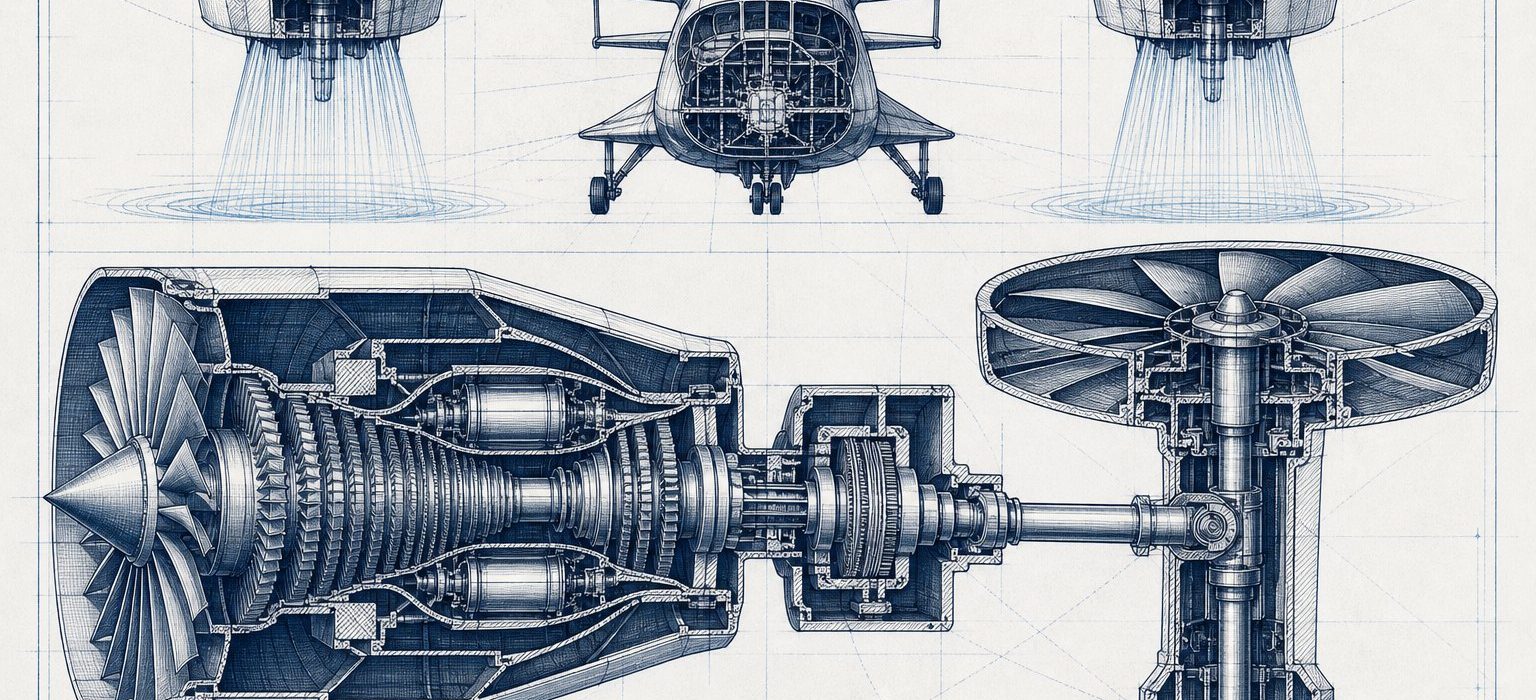
Vertical landing is not hard because lifting an aircraft straight up is hard. It is hard because an engine sized to hover is the wrong engine for cruising, and an engine sized to cruise cannot hover. US Patent 5209428 describes one way out of that bind.
What the document covers
The patent, titled “Propulsion system for a vertical and short takeoff and landing aircraft”, was filed on 1990-05-07 and granted on 1993-05-11, assigned to Lockheed Corp. The named inventors are Paul M. Bevilaqua, Paul K. Shumpert.
The arrangement it sets out is compact enough to state in a sentence. A turbofan engine has its low-pressure turbine coupled to the fan section as usual. A second fan — the lift fan — sits separately in the airframe and is coupled to that same fan section through a drive shaft. A clutch sits in between. Additional power is extracted from the low-pressure turbine to drive the lift fan, and that lift augments the basic engine thrust when the aircraft needs to hover.
Why the clutch is the whole idea
The clutch is what makes the arrangement work rather than merely exist. In forward flight it is disengaged: the lift fan is dead weight, the engine behaves as an ordinary turbofan, and the aircraft has the cruise efficiency of a conventional design. For vertical operation the clutch engages and a large, slow-turning fan begins moving a great deal of air at relatively low velocity.
That last point matters more than it first appears. Thrust can be produced by moving a small mass of air very fast or a large mass of air moderately fast. The first approach is what a pure jet does, and in hover it means an extremely hot, extremely fast column of exhaust directed at whatever surface the aircraft is descending onto. The second approach spreads the same lift over far more air at far lower temperature and velocity.
The problem it inherited
Earlier vertical-landing designs took a different route: split the engine exhaust and vector it downward through rotating nozzles. That works, and aircraft built on the principle flew for decades. But it puts the full heat and velocity of the engine efflux onto the ground, it limits how much lift is available for a given engine, and it constrains where the aircraft can operate from.
The lift-fan arrangement decouples those constraints. The fan can be sized for hover independently of the engine core, and the air it moves has never been through the combustor.
Reading the claim
The granted claim set here is narrow — a single independent claim. That is worth noticing. A single claim does not mean a weak patent; it often means a specific combination that the examiner and applicant settled on precisely. The elements are recited together: turbofan with the stated turbine split, lift fan, drive shaft, clutch, and the mechanism for extracting additional power from the low-pressure turbine. An arrangement that omits any one of them falls outside the claim.
This is the usual lesson of reading claims rather than abstracts. The abstract describes a field. The claim describes the fence.
Where it sits in the record
The patent is one of the most heavily referenced documents in this archive. Its subject matter falls under propulsion arrangements for vertical takeoff aircraft; related material can be browsed through the classification index, and other filings by the same assignee through the assignee records.
The full specification, including the drawings this summary does not reproduce, is held by the patent office. Every entry in this archive links directly to it.
The engineering price of the clutch
Describing a clutch in a claim takes one line. Building one takes rather more. The component has to transmit the power required to spin a large lift fan, engage under conditions where the two sides are turning at very different speeds, and then sit disengaged and unloaded for the whole of a cruise leg without degrading. It also has to weigh very little, because every kilogram in the airframe is a kilogram the fan has to lift.
That set of demands is why the arrangement remained a paper concept long after the aerodynamics were understood. The idea of driving a lift fan from the main engine is not subtle and did not need inventing in 1990. What needed solving was the transmission, and a patent claim that recites a clutch is claiming the solution to that problem in its context, not the general notion of connecting two rotating things.
The drive shaft carries the same burden. It runs from the engine to a fan mounted elsewhere in the airframe, through structure that flexes in flight, and it has to stay aligned well enough to avoid destroying itself. Shaft-driven arrangements in rotorcraft had established much of the relevant practice; applying it to a fan turning at turbofan speeds was the step being taken here.
Why the filing date matters
The document was filed in May 1990 and granted in May 1993 — three years in examination, which is unremarkable for mechanical subject matter of this complexity. The filing date is the one that establishes priority, and it is the date to reason from when placing a patent against the technical state of its field.
Reading it as a 1993 document, the grant year printed most prominently on the front page, puts it three years out of position. This is a routine error and worth guarding against on any patent record.
Following the thread in this archive
The assignee record for the holder collects the other filings compiled here under the same organisation, which is usually a faster route into a technology area than searching by keyword. The classification index approaches the same material by subject: propulsion arrangements sit within the mechanical engineering section, and browsing a section surfaces documents whose titles share no vocabulary at all.
Both routes are more reliable than a title search. Patent titles are written to be accurate rather than descriptive, and a great many of them succeed at the first without attempting the second.